

Stepping Stones | All Colors, Autumn Blend & More
Stepping stones may appear simple, yet they play a surprisingly important role in landscape design, outdoor circulation, and garden aesthetics. Whether used across lawns, gravel paths, or courtyard transitions, they help guide movement while preserving the natural character of the surrounding space. Natural stone stepping stones, especially sandstone varieties from India, remain widely used in global landscaping because of their durability, color range, and weathering behavior.
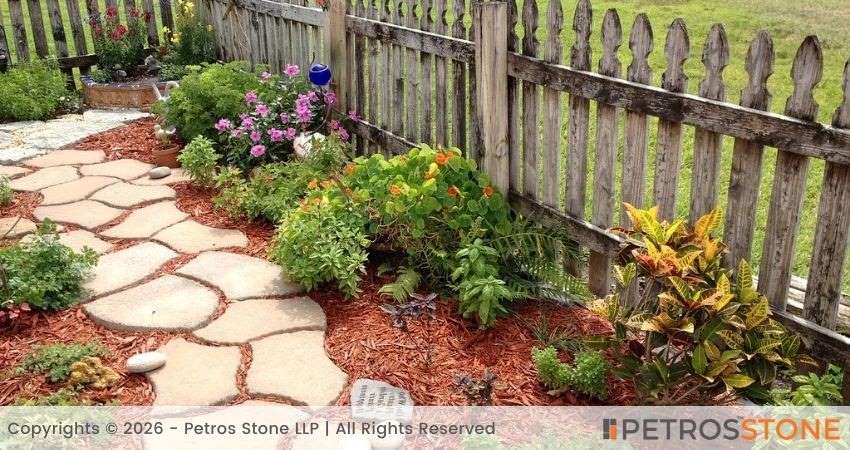
In fact, India continues to be a major exporter of natural stone, with industry bodies like CAPEXIL reporting exports of natural stones and related products valued at roughly US$2.08 billion in recent years.
In this article, we explore what stepping stones actually are, the most popular colors such as Autumn Blend and Kandla Grey, available shapes and finishes, technical standards buyers should understand, pricing considerations, export insights, and practical tips for selecting the right stone for your project.
What Stepping Stones Actually Are
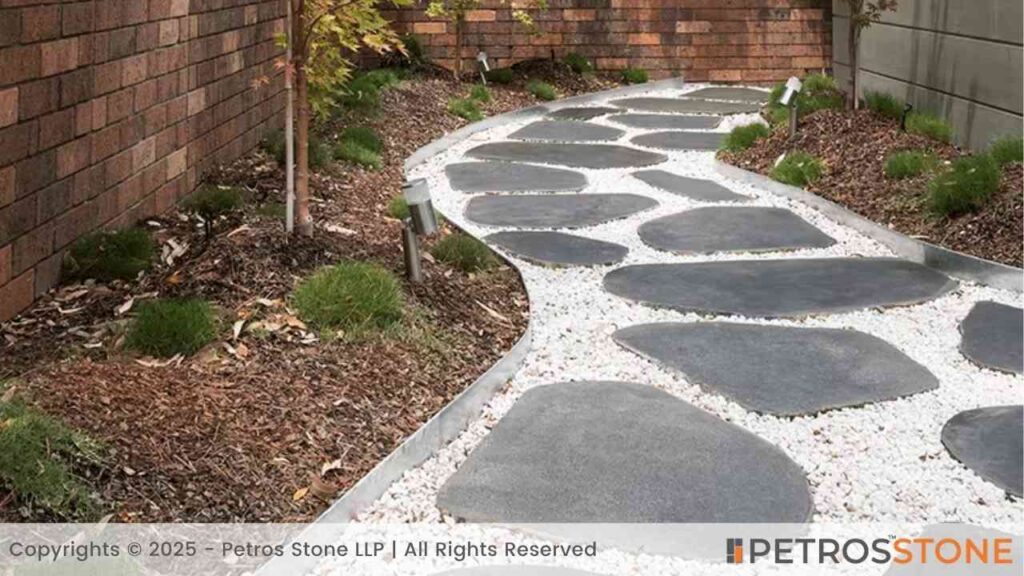
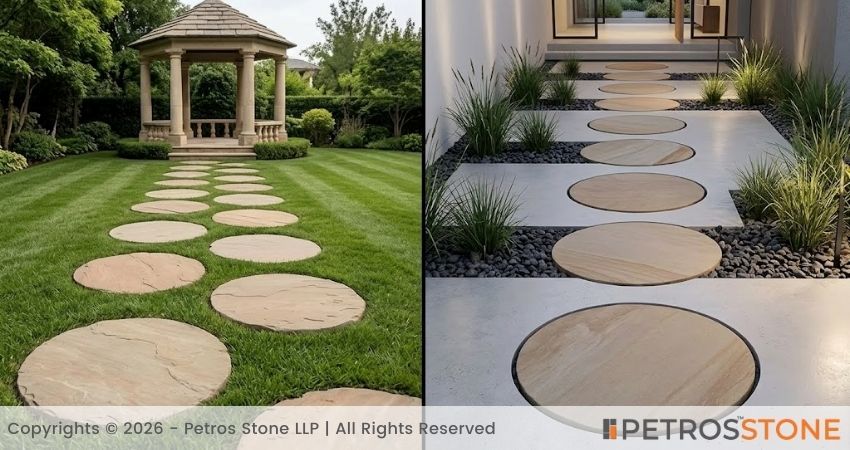
At the most basic level, stepping stones are discrete paving stones placed with intentional gaps between them, usually over lawn, gravel, mulch, or a compacted base. They are meant to guide movement without creating a full, continuous paved surface. In landscape design, that small difference matters. A patio slab covers the ground. A stepping stone path choreographs movement through it. That is one reason landscape designers keep returning to them: they create direction without over-hardscaping the site.
Colors and Stone Varieties Buyers Usually Ask For

Color is usually the first conversation, but not always for the reasons buyers think. In stepping stones, color is not just a design matter. It affects how the path hides mud splashes, leaf marks, dust, algae, and seasonal wear.
Popular stepping stone colors include Autumn Brown for warm natural landscapes, Kandla Grey for contemporary gardens, and Raj Green for English-style settings. Teakwood or plank-style stones are sometimes used in resort landscapes where a linear stepping effect is desired. Then there are mint, beige, and other light tones. These can look elegant, but they also show dirt and staining more quickly outdoors. They work best where maintenance is good, and the design intentionally wants brightness.
Mixed-color stepping stones make sense when the project is aiming for a highly natural feel. On lawns, in woodland paths, or around farmhouse landscapes, mixed lots can look less staged and more settled into the ground. That said, mixed lots need tighter visual approval at the dispatch stage.
A practical export insight here is simple – Once a container is packed, ‘natural variation’ no longer sounds charming if the buyer expected tighter shade control. That is why exporters typically have to photograph, batch, and mark lots more carefully for stepping stones than for regular random paving.
Why Autumn Brown Stepping Stone is so Popular?
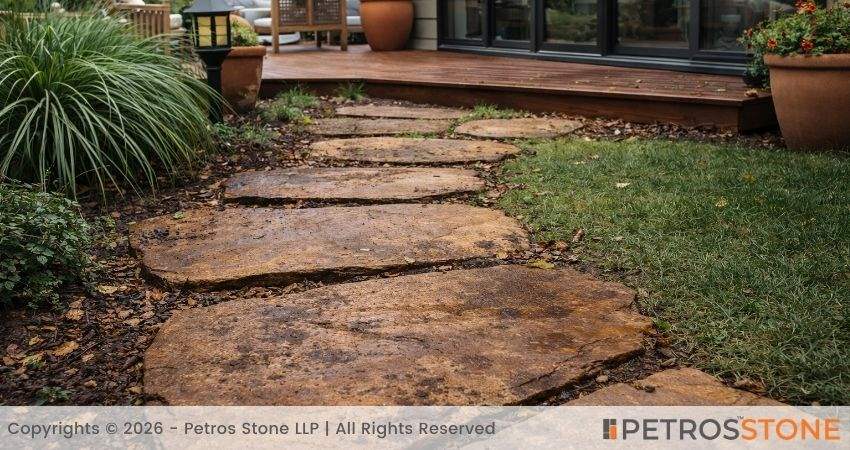
Autumn Brown leads demand for one simple reason: it is forgiving. It sits comfortably between warm and neutral. It can work next to timber decking, beige walls, terracotta planters, black exterior lights, and even modern glass-heavy facades without looking out of place.
It also hides daily use well. A stone path is rarely kept pristine. It gets muddy footprints, irrigation splash, dry dust, and leaf tannins. Autumn Brown’s natural variation makes these marks less obvious than they would be on pale-cream stone or highly uniform grey surfaces. That is not a technical test result; it is a real-site observation repeated across landscape jobs.
From a shipping perspective, Autumn Brown is also commercially practical. Mixed but harmonious shade movement means a container with small natural variation is still acceptable in many markets. That reduces the risk of rejection compared to very uniform colors, where even modest shade drift can trigger claims.
Any exporter handling repeated stepping-stone orders learns this quickly. The product that looks ‘visually alive’ in the yard is often the product that survives logistics and installation complaints more easily.
Shapes, Sizes, Thickness, and Edge Styles of Stepping Stones
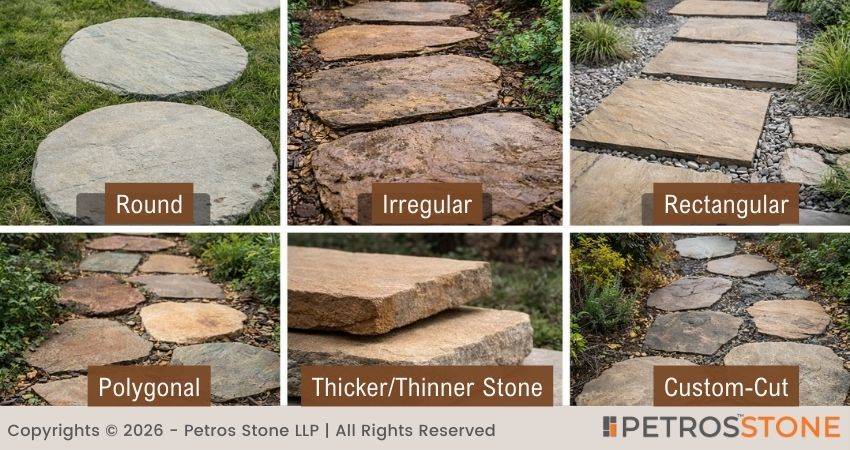
Stepping stones are sold in more forms than many first-time buyers expect. The common shapes include round pieces, irregular hand-cut formats, polygonal pieces, rectangular slabs, and custom-cut profiles. Irregular and polygonal stepping stones are usually chosen for the most natural garden appearance. Round formats are popular for lawns and water-feature zones. Rectangular and custom-cut stones suit more formal projects.
Thickness matters more than many buyers assume. For ordinary garden paths over stable, compacted ground, lighter thicknesses can work. For heavier-use walkways, public landscapes, or places where substrate movement is likely, thicker material is safer. Finish matters too:
Common finishes include natural cleft for outdoor grip, calibrated thickness for easier installation, tumbled edges for an aged look, and sawn edges for contemporary layouts. Calibrated and custom-shaped stones cost more because they involve extra cutting, sorting, and machining. Buyers often focus on the FOB price but overlook that installation costs usually drop when thickness and shape are better controlled. So the cheaper uncalibrated piece is not always the cheaper job.
Technical Standards and Test Benchmarks
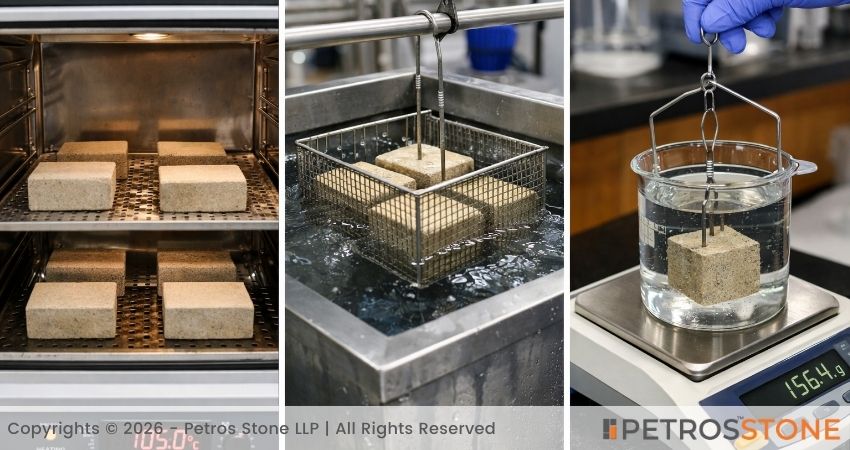
For sandstone stepping stones, the discussion should not stop at appearance. At a minimum, buyers should understand which technical values matter and which standards are commonly referenced.
In India, IS 3622 covers sandstone slabs and tiles and was framed because only sandstones meeting certain strength and compactness requirements are suitable for building use. That matters directly to stepping stones, because outdoor paving pieces are exposed to wetting, drying, impact, and movement. The Indian Bureau of Mines also identifies sandstone as a major dimension stone category with wide building use and export relevance.
From the ASTM side, the Natural Stone Institute points specifiers toward tests for:
- Absorption and density (ASTM C97),
- Compressive strength (ASTM C170),
- Bending/flexural strength (ASTM C99 or C880, depending on the condition),
- Along with abrasion and slip-related requirements, depending on use.
Key Technical Data Buyers Should Request Before a Bulk Order
Before placing a large order of sandstone stepping stones, buyers should request verified technical data from the supplier or testing laboratory. These values help determine whether the stone will perform reliably in outdoor conditions.
| Technical Parameter | Why It Matters |
|---|---|
| Water Absorption | Indicates how much moisture the stone can absorb. Lower absorption generally means better durability in wet outdoor environments. |
| Bulk Density | Shows the compactness of the stone. Higher density stones are typically stronger and more durable. |
| Compressive Strength | Measures the stone’s ability to withstand heavy loads without crushing. This is critical for paving and stepping stones. |
| Flexural (Bending) Strength | Indicates how well the stone resists bending or cracking under load, especially important for thinner stones. |
| Abrasion Resistance | Shows how well the surface resists wear from foot traffic, sand, and debris. |
| Slip Resistance / Surface Finish Information | For outdoor pedestrian areas, the finish must provide adequate grip to reduce slipping, especially in wet conditions. |
These technical properties are typically measured according to standards published by organizations such as ASTM International (for example ASTM C97, ASTM C170, and ASTM C99) and the Bureau of Indian Standards. Requesting certified test results helps buyers verify that the stone meets structural and durability requirements before committing to large shipments.
Best Uses for Stepping Stones

Stepping stones are ideal where full paving would feel excessive. Garden pathways are the obvious use, especially through lawns, planted areas, or around kitchen gardens. They also work well for lawn trails and villa landscapes because they visually preserve more green cover.
In courtyards and patio transitions, stepping stones can soften the move from built surface to planted edge. Resorts, farmhouses, and hospitality projects use them heavily because they create movement and mood simultaneously. In public landscapes and institutional campuses, they can be effective in lower-speed pedestrian areas, though heavily trafficked public zones often require more controlled paving systems instead.
The material choice should respond to the level of use. A decorative stepping path in a private garden can tolerate more irregularity. A path outside guest villas or in a resort circulation zone usually needs tighter sizing and more stable installation.
Installation Basics That Affect Long-Term Performance
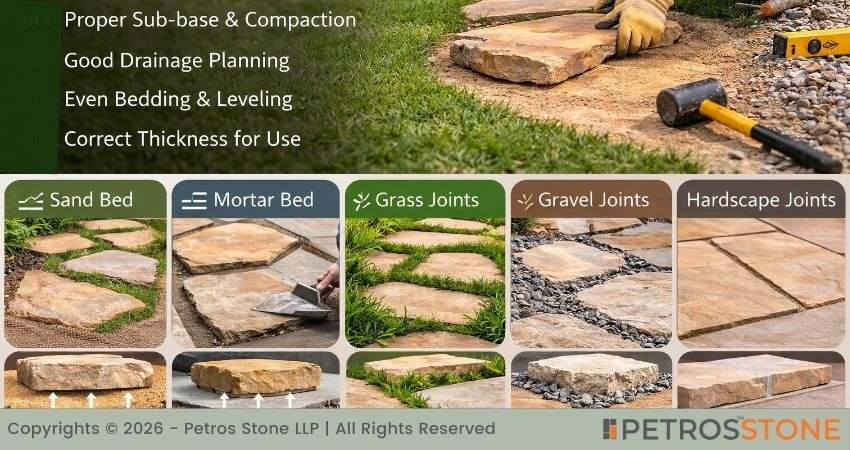
Most failures people blame on the stone are actually installation failures.
A sand bed works well for garden stepping paths where the design is informal, drainage is good, and the pieces are meant to sit naturally within the lawn or gravel. A mortar bed is more appropriate where movement must be tightly controlled or where the sub-base is more engineered.
Jointing choices depend on layout:
- grass joints for the most natural look,
- gravel joints for drainage and lower maintenance,
- hardscape joints where a cleaner edge is needed.
Common mistakes include poor compaction, no drainage planning, using stones with uneven bedding faces without compensation, and installing thin material where a heavier thickness was needed.
Disclaimer – This video is for informational purpose and all copyrights, trademarks, and ownership remain with the respective creator and original publisher on YouTube.
Pricing
Export buyers should compare FOB, CIF, and final landed cost rather than just the ex-yard price, since freight, duties, inland transport, and breakage can significantly change the total cost.
| Stone Type / Color | Thickness | Finish | Shape | Typical FOB Price (India) | Estimated CIF Price (US/EU) | Notes |
|---|---|---|---|---|---|---|
| Kandla Grey Sandstone | 25–30 mm | Natural / Split | Round 400–450 mm | ₹260–₹320 / piece ($3.10–$3.85) | $4.80–$5.80 / piece | Most exported stepping stone; stable supply |
| Kandla Grey Sandstone | 30–35 mm | Calibrated + Sandblasted | Round 400–450 mm | ₹330–₹390 / piece ($4.00–$4.70) | $5.90–$6.80 / piece | Higher machining cost due to calibration |
| Autumn Blend Sandstone | 25–30 mm | Natural / Split | Random Polygon | ₹300–₹360 / piece ($3.60–$4.30) | $5.20–$6.20 / piece | Color variation increases sorting cost |
| Raj Green Sandstone | 25–30 mm | Natural / Hand Split | Round 450 mm | ₹290–₹350 / piece ($3.50–$4.20) | $5.00–$6.00 / piece | Popular in UK landscaping projects |
| Mint Fossil Sandstone | 25–30 mm | Honed or Sandblasted | Round / Square | ₹340–₹420 / piece ($4.10–$5.05) | $6.00–$7.20 / piece | Fossil patterns increase quarry sorting |
| Teakwood Sandstone | 30–40 mm | Natural | Round / Freeform | ₹380–₹480 / piece ($4.60–$5.80) | $6.70–$8.10 / piece | Higher freight weight due to density |
| Rainbow Sandstone | 25–30 mm | Natural | Random Shape | ₹360–₹450 / piece ($4.30–$5.40) | $6.30–$7.60 / piece | Limited quarry yield |
What Impacts the Price the Most?
The final price of sandstone stepping stones is influenced by several technical and logistical factors. The most important ones include:
Table of Factors that Affect Pricing
| Factor | How It Affects Price |
|---|---|
| Stone Type | Different sandstones have different quarry costs and availability. Premium varieties with consistent grain and strength typically cost more. |
| Color Rarity | Rare or highly sought-after colors (such as fossil-rich or multicolor stones) require additional sorting at the quarry and factory, increasing cost. |
| Thickness | Thicker stones use more raw material and increase shipping weight, which raises both production and freight costs. |
| Finish | Surface finishes like sandblasted, honed, or brushed require additional factory processing compared to natural split finishes. |
| Shape Complexity | Standard rectangles or squares are cheaper. Circles, templates, and irregular shapes reduce cutting yield and require more machine time. |
| Calibration | Machine calibration ensures uniform thickness for faster installation but adds machining and tooling cost. |
| Packing Style | Strong export crates, fumigated pallets, and foam protection increase FOB cost but significantly reduce breakage during shipping. |
| Order Volume | Larger orders (especially full container loads) reduce the per-piece cost because processing, packing, and freight become more efficient. |
Practical Buyer Insight
When comparing quotes, professional buyers focus not only on the FOB price but also on packing quality, freight efficiency, and breakage risk. In natural stone exports, the shipment with the lowest invoice price is not always the cheapest once it reaches the destination port.
Export and Market Demand
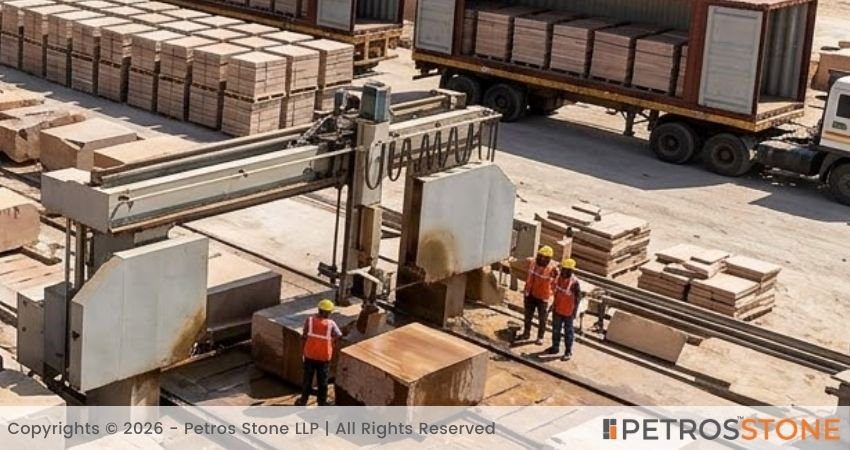

Indian stepping stones remain relevant internationally because India still has a strong natural stone processing base and a broad stone palette. CAPEXIL reports that India’s Natural Stones and Products exports reached roughly US$2.08 billion in 2022-23. The Ministry of Commerce has also continued to highlight resilience in merchandise exports more broadly, while industry platforms such as CAPEXIL’s 2025 insights have tied trade shows like STONA 2025 to efforts to strengthen India’s global natural stone position.

Autumn and other neutral sandstone tones travel well internationally, partly because they cross design styles more easily than very specific regional colors. That is an industry inference rather than an official statistic. Still, it lines up with what exporters see repeatedly: earthy, muted tones are easier to place across the UK, Europe, North America, and hospitality-led projects than stones that are too stark or too locally coded.
Pros of Natural Stone Stepping Stones
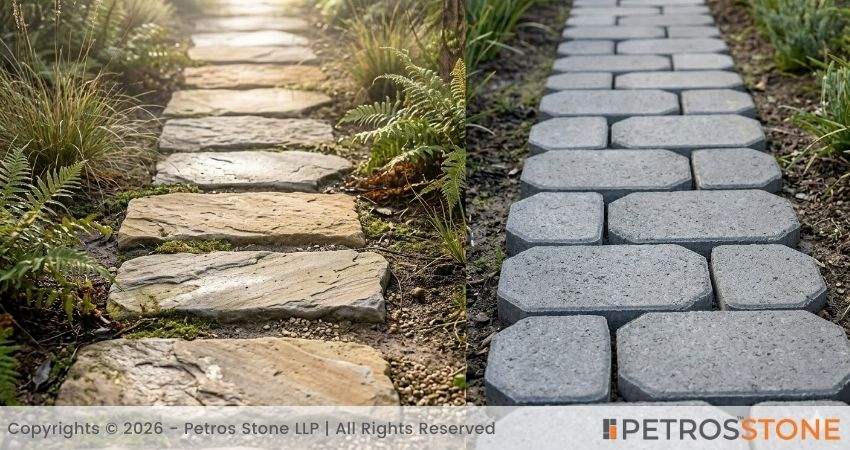
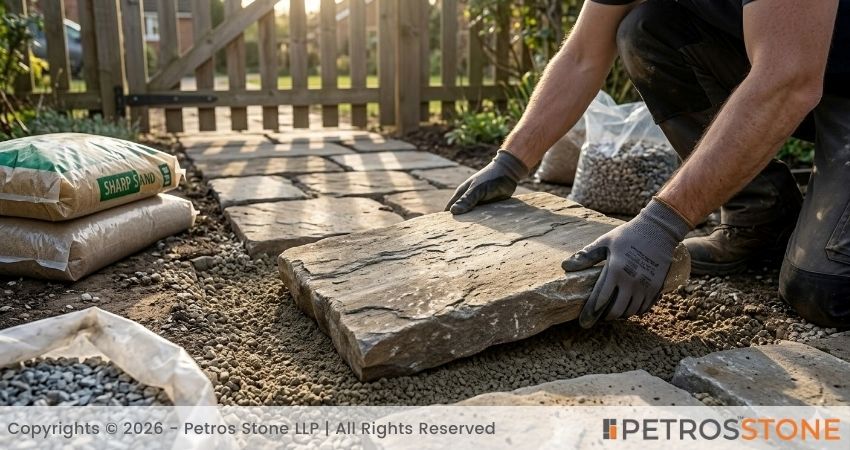
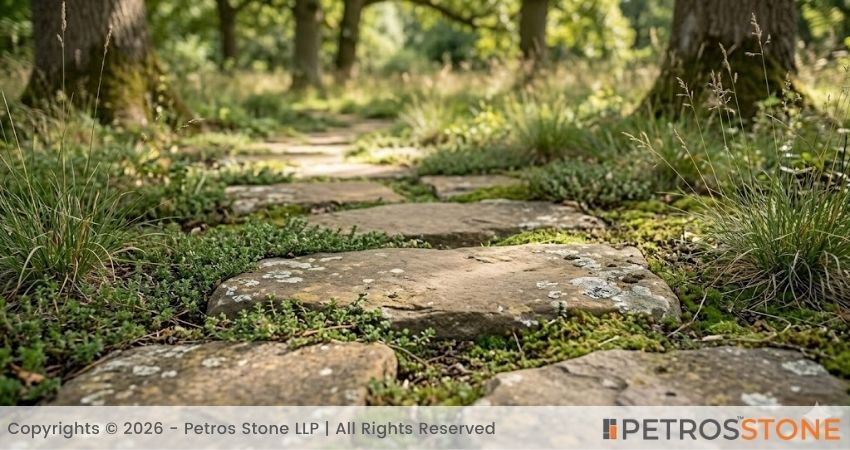
- The first advantage is visual character. Concrete replicas can be neat, but they rarely weather as convincingly as real stone.
- The second is repairability. If a stepping stone cracks or a path layout changes, individual pieces can usually be replaced or re-spaced without rebuilding a whole surface.
- The third is service life. When the right stone is selected, tested, properly packed, and installed on a sound base, stepping stones can last for years outdoors with very little drama.
Natural stone also tends to age into the landscape rather than sitting on top of it. That is one reason landscape professionals continue to prefer it in gardens and transition zones.
Limitations and Risks Buyers Should Know
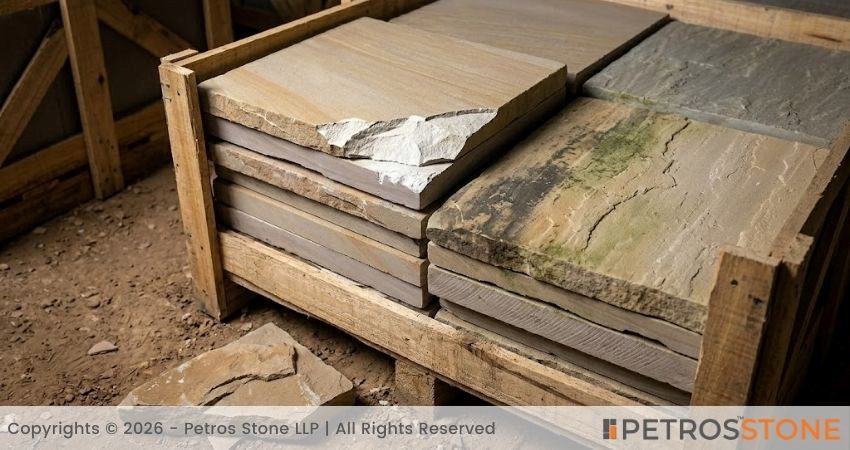
Natural stone is not uniform, and that is both its strength and its risk. Color variation from lot to lot is real. Some stones can have layering or bedding planes that make edge breakage more likely if they are used too thin or handled roughly. More porous stones may benefit from sealing, especially in wet, shaded sites where algae and leaf staining are persistent. Shipping damage is another reality; heavy, irregular pieces can knock against one another if crates are not properly blocked and strapped.
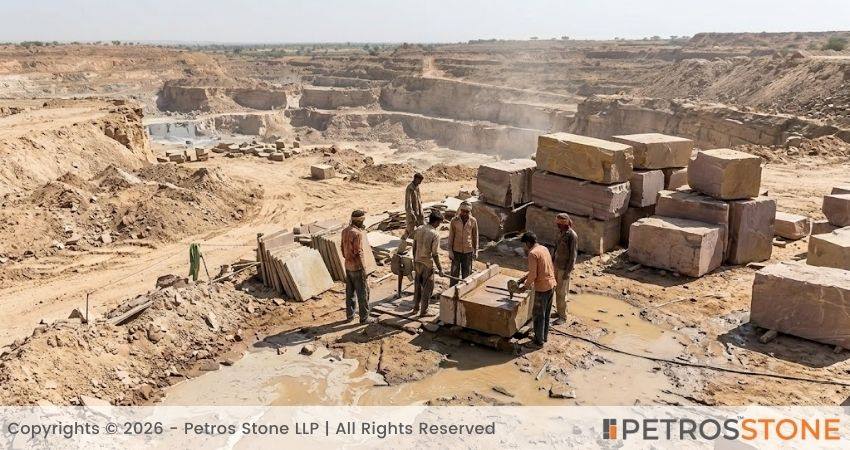
There is also a broader sustainability and social-risk side to stone sourcing. An independent study on sandstone quarrying in Rajasthan documented significant environmental and labor concerns in parts of the supply chain, which is exactly why buyers should ask not just what the stone is, but where and how it was produced.
How to Choose the Right Stepping Stone for Your Project
If you want the most natural garden look, choose irregular or lightly varied pieces in tones like Autumn Brown or Raj Green with a natural cleft face
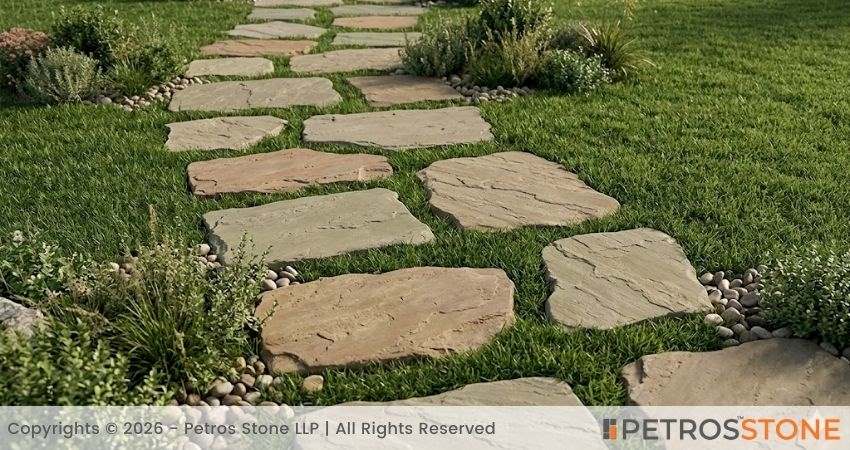
If you want lower maintenance, choose denser stone, avoid very pale colors in muddy gardens, and consider calibrated pieces to make the installation easier and more stable.
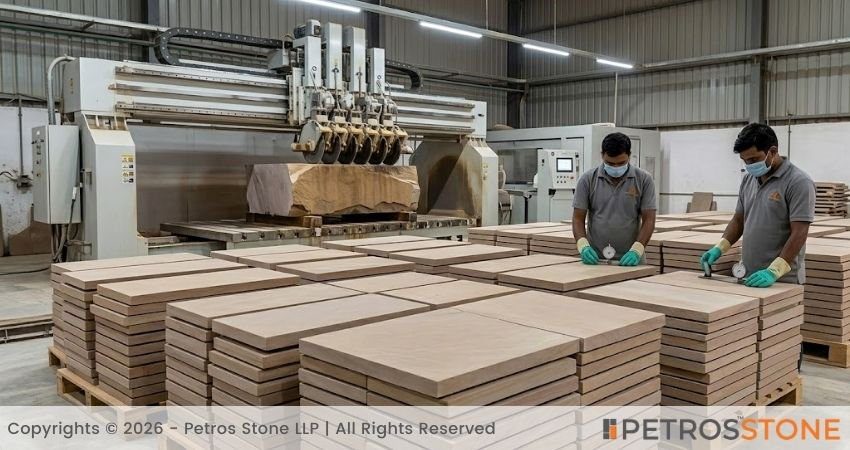
If you are buying for export, focus heavily on batching, thickness tolerance, and crate quality. Approve the shade range in writing before loading.
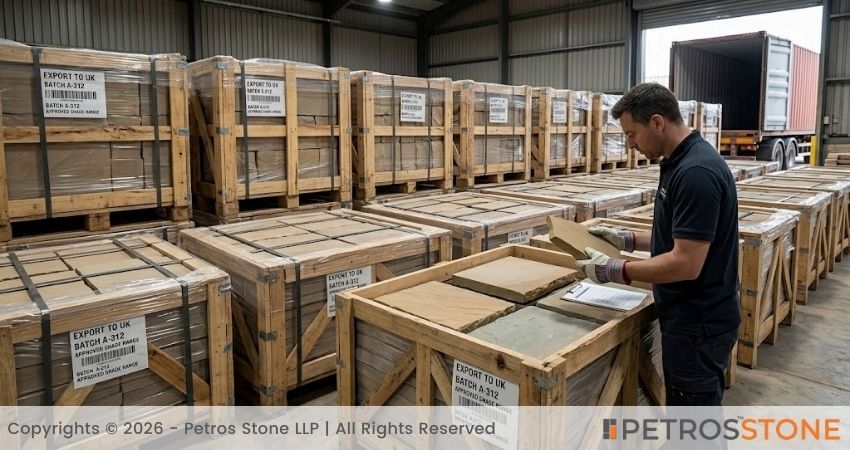
If you are buying for a landscape architect or builder project, match the stone to the traffic level, substrate condition, and design language. A villa lawn path and a resort arrival walkway are not the same job, even if both are called stepping stones.
FAQs
Which color is best for stepping stones?
There is no single best color, but Autumn Brown is often the safest all-around choice because it hides dirt and works in both rustic and modern settings.
Is Autumn Brown sandstone good for outdoor pathways?
Yes, provided the stone quality is sound, the finish is appropriate, and the path is installed on a proper base.
What thickness is ideal for garden stepping stones?
It depends on use and stone type, but heavier-use paths generally need thicker pieces than light garden trails.
Do stepping stones need sealing?
Not always, but some stones benefit from sealing depending on porosity, shade conditions, and maintenance expectations.
Are natural stepping stones slippery when wet?
That depends on the finish. Natural cleft and textured finishes are usually safer outdoors than smoother polished finishes. Slip suitability should be considered along with relevant test data where required.
How many stepping stones are needed per square meter or running path?
There is no fixed rule because spacing varies by design and stride length. The layout should be planned based on walking rhythm, not just area math.
Key Takeaways
- Installation quality determines long-term performance. Even high-quality natural stone stepping stones perform best when installed on a stable base with proper spacing, drainage, and alignment.
- Choose stone based on performance, not just color. While Autumn Brown is a popular option, the right stepping stone should match the site conditions, traffic level, and landscape design requirements.
- Check technical specifications before buying. Reliable suppliers provide lab-tested values such as density, water absorption, and compressive strength based on standards like ASTM and BIS.
- Understand processing quality. Proper splitting, calibration, and finishing at the factory significantly affect durability, appearance, and ease of installation.
- Evaluate packaging and export readiness. For international shipments, strong pallet packing, proper crate protection, and consistent sizing help prevent damage and installation issues.
Feel free to get in touch for a free consultation, quote, and get a detailed understanding from our experts here at Petros®. Visit https://petrosscape.com/ or call +91-8446360361 and WhatsApp

Hi, I’m Shivangi,
With years of experience in the architecture and design space, I write to bridge the gap between material knowledge and practical application. At Petros® Stone, I create content that highlights the beauty, function, and impact of natural stones, helping homeowners and professionals make confident design decisions.
Explore my LinkedIn profile to learn more about my work!