

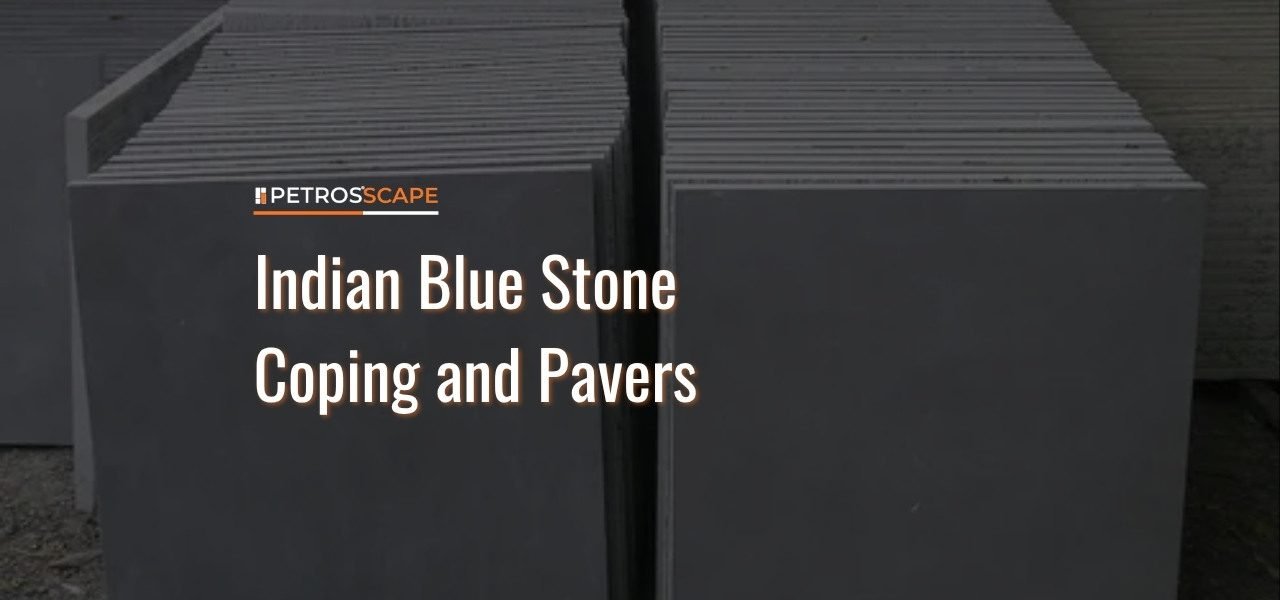
Indian Blue Stone | Coping and Pavers
Indian Bluestone is one of the unique natural stones of India. This limestone exhibits a pleasing blend of blue and grey tones.
The textured surface and excellent durability make it one of the most practical choices for flooring, cladding, and coping.

Specifications of Indian Blue Stone
| Type of Stone | Limestone |
| Origin | South India |
| Visual Appearance | Bluish-grey tone with a natural cleft surface. |
| Size | Available in different sizes in the form of slabs and tiles. |
| Thickness | Multiple thicknesses ranging from 15mm to 50mm+. |
| Common Finishes | Natural, Honed, Brushed, Sandblasted, Polished, etc. |
| Cost | USD 0.30 – USD 0.80 per sq. ft. |
In this article, we explore Indian Bluestone, a durable limestone from South India known for its natural blue-grey tones and textured surface that suits both modern and rustic designs. We break down its key properties, such as density, water absorption, and compressive strength along with practical applications like coping, paving, patios, and driveways.
Features of Indian Bluestone
Neutral and Rustic Appearance

Bluestone is known for its neutral palette. The mix of blue and grey makes it versatile in terms of pairing up with other stones. While the blue tones remain prevalent, a few slabs may also exhibit hints of purple and green shades.
Furthermore, the natural cleft surface imparts a rustic essence to the stone. It complements both modern and traditional design languages.
Durability


Indian Bluestone is a dense, hard natural stone. A natural limestone with primary composition of carbon minerals, this stone is durable and weather-resistant.
The water absorption rate, ranging between 0.5% and 3%, makes it ideal for outdoor applications. Additionally, with a compressive strength between 55 and 120 MPa, it remains sturdy and can withstand heavy loads and rough usage.
Textured Surface
Limestone’s textured surface enhances the anti-slip properties of the stone. It also helps curate an effective tactical experience, adding richness to the overall design– practically and visually.
Recommended Finishes of Bluestone
| Application | Best-suited Finishes |
| Pool Deck | Light brushed/ Flamed/ Honed |
| Driveway | Natural/ Sawn/ Bush Hammered |
| Patio | Honed/ Natural |
| Feature Walls or Interior Flooring | Honed/ Polished |

Varying Shapes

Indian Bluestone is available in several shapes other than the typical square and rectangular formats.
Indian Bluestone – Varying Shapes
| Shape | Description | Common Applications |
| Mixed | Unusual and irregular shape. | Informal style patios, pathways, and courtyards. |
| Irregular | An organic shape that is either formed naturally or attained by minimal cutting. | Rustic and organic gardens. |
| Square or Rectangle | Precisely cut to size for a defined shape. | Modern and formal pathways, courtyards, patios, etc. |
| Custom Cut | Tailored in different shapes for a geometric or mosaic pattern. | Designer paving, drop-off areas, deck, etc. |
Cold Underfoot
Indian Bluestone remains cool even when exposed to sunlight. The cool underfoot ensures comfort in both indoor and outdoor flooring, especially in the hot climatic zones.
Why Does Bluestone Remain Cold?
In the hot climate of India, Bluestone stands out as a hero stone due to its thermal behaviour. Rather than radiating heat, it absorbs and disperses heat. This property helps keep the surface of the stone at a moderate temperature, even under scorching heat.
The stone’s density ranges between 2.5 and 2.8 g/m³ (ASTM C67), contributing to the heat retention property.
Its balanced heat retention cycle makes Bluestone an ideal choice for pool deck paving, coping, walkways, patios, etc.

Applications of Indian Bluestone
1. Coping
Bluestone is one of the top choices for both wall and pool coping. It is primarily due to its resistance to weathering and low water absorption rate.
Its dense composition effortlessly resists heat, cracking, and chipping. Additionally, the ease of workability helps craft coping in different styles.

Coping Styles and Their Applications
| Style of Coping | Description | Applications |
| Bullnose Coping | A rounded edge in the front. | Pool deck, steps, seating, etc. |
| Chamfered Coping | Edges cut at an angle. | Steps |
| Flat Coping | Straight and sharp edge. | Parapet walls, plinth, terraces, etc. |
| Half-Round Coping | Semi-circular edge. | Pool coping, landscape seating. |
| Drip-Grooved Coping | Either flat or profiled edge with a groove under it. | Retaining walls, parapet walls, pool edges, etc. |
Pro-tip: Never miss adding a drip groove under the edge of the coping. A small groove helps cut the water run-off towards the wall.
Choosing the Appropriate Thickness


| Thickness Range | Load Capacity | Best Use Case |
| 15mm-20mm | Low | Wall cladding, interior flooring, low-use balconies, etc. |
| 20mm-25mm | Moderate (Foot Traffic) | Balconies, covered patios, pathways, etc. |
| 25mm-30mm | Moderate to High (Foot Traffic) | Courtyard, patio, paving, etc. |
| 30mm-40mm | High (Foot Traffic) | Pool deck, coping, public walkways, etc. |
| 40mm-50mm | Low (Vehicular Load) | Parking, driveway, drop-off area, etc. |
| 50mm+ | High (Vehicular Load) | Heavy-duty driveways, service areas, commercial plazas, etc. |
2. Pavers
Natural stone pavers serve as the structural foundation of any high-end landscape, bridging the gap between raw outdoor environments and refined architectural design. Beyond their obvious aesthetic appeal offering a rich tapestry of organic textures and deep, earthy hues, pavers are engineered by nature to withstand the harshest conditions, from intense thermal expansion to heavy load-bearing requirements. Whether arranged in a seamless, modern tight-joint pattern or a rustic, wide-joint layout, they provide a slip-resistant and incredibly durable surface that matures gracefully over time. Investing in quality paving is not just about creating a functional walkway; it is about establishing a permanent, low-maintenance heritage for a property that increases in character with every passing season.

Types of Joint Treatment in Bluestone Paving
| Type of Joint | Width/ Infill | Appearance |
| Tight Joint | 10mm-15mm | Refined and contemporary aesthetics. |
| Wide Joint | 20mm-50mm | Rustic character. |
| Green Joint | Filled with weeds or grass | Softens the hardscape appearance. |
| Gravel-filled Joint | Gravel infill | Textured look with enhanced drainage. |
3. Patio

Indian Bluestone is one of the top choices for patio paving. The textured surface, neutral aesthetics, and flexibility in its shape and size make it favourable for patios.
While irregular stones can be used for an organic and informal look, on the other hand, regular-shaped paving leads to formal aesthetics.
Pro-tip: Avoid selecting a polished surface for patio paving, especially if it’s not covered. Polished finish may lead to slipperiness.
4. Pool Deck

Pool decks demand an aesthetic and practical flooring. As these are often used barefoot, Indian Bluestone serves as an excellent choice with its thermal performance.
Its resistance to weathering and cool underfoot minimises the risk of burn even on a hot summer day. Furthermore, the anti-slip properties offer essential safety for pool decks and other wet areas.
Pro-tip: To make the surface comfortable, opt for a lightly brushed or honed finish. Natural finish, while excellent in anti-slip properties, may feel rough and uncomfortable.
5. Pathways

Whether you’re planning an organic trail or a well-defined pathway, Indian Bluestone works well in both cases.
Especially popular as flagstone, its dark tones complement the natural landscape palette. The durable nature of this limestone enhances its longevity.
Pro-tip: For a rustic look, go for green joints.
6. Driveways

As this natural stone is sturdy, it can withstand heavy loads. Apart from the pedestrian paving, Indian Bluestone can also be added to the driveways as an aesthetic and structurally sound option.
Pro-tip: To bear the vehicular load, consider choosing the stone with a minimum thickness of 40mm for driveway paving.
Challenges of Indian Blue Stone

Dependency on Skilled Labor
Unlike other natural stones following predefined shapes and sizes, Bluestone is popularly adopted in an irregular format. In this case, it demands skilled labour for a visually balanced installation of the paving.
Working with skilled labour is critical as the installation carried out by an inexperienced team may result in poor alignment of the stone, uneven joints and unpleasant aesthetics.
Level Control
The installation of Indian Bluestone in the pool deck and pathways demands precise levelling. Proper sub-base preparation and slope help in naturally curating the drainage route.
Achieving the slope demands additional mortar adjustments in terms of its thickness, increasing the manual effort along with overall time.
Time-Consuming Installation
Installation of this stone is a time-consuming process, especially when the irregular shapes are assembled to form a visually comforting pattern. Thus, it can be challenging for projects with a tight timeline.
Base Preparation
One of the most challenging yet critical aspects of laying Indian Bluestone is its sub-base preparation. A well-settled sub-base and even surface lead to the longevity of the paving.
On the other hand, an improper base leads to poor drainage, stone displacement, uneven walking surface, which eventually leads to cracking of the stone under load.
Tonal Variation
Limestone is known for its natural palette and varying hues. It exhibits colour variation in each batch, and this may not be suitable for designs demanding a consistent look.
Replacement Challenge
Unlike the other conventional paving materials, the replacement of Bluestone flagstone can be a challenge on its own. The irregular shapes make it difficult to replace it with a precise match.
Key Takeaways
- Indian Bluestone is one of the finest natural stones of India. Other than its eye-pleasing aesthetics, this stone has proven its relevance in terms of strength.
- High durability, weather resistance, ease of workability, and climate responsiveness make it an ideal choice, especially for landscape applications. While its irregular geometry may pose installation and design challenges, a thoughtfully curated design induces timelessness in every design.
- When it comes to working with this material, quality control and consistency are the keys to aesthetic and functional spaces. This is where choosing the right supplier comes into the picture.
At Petros®, our stringent quality checks ensure that every slab is consistent in its texture, thickness, and structure. To explore the wide range of Indian Bluestone shapes and sizes, connect with us.
Feel free to get in touch for a free consultation, quote, and get a detailed understanding from our experts here at Petros®. Visit https://petrosscape.com/ or call +91-8446360361 and WhatsApp

Hello!
I’m Tanika, an architect and writer, blending design expertise with a passion for storytelling. At Petros Stone, I help readers navigate through the complex material choices and empower them to craft well-informed and beautiful spaces through natural stones.